

Today I’ll tell you all about my experience regarding an exercise that I usually do when I develop project prototypes or propose strategies and which I think could be useful for you as well.
It’s called the empathy map, a tool designed by the company Xplane, that facilitates the identification of the characteristics of potential customers that we want to have in our company.
At Paula Baldó, this is not this tool’s only purpose, as it also can be used to work in advance with a company’s potential stakeholders when designing its sustainability strategies. It’s also a marvelous resource to complement the information and results obtained with the #sustoolkit.
Once we have identified our stakeholders, by working on their indiviual empathy maps we can anticipate their needs and interests and thus facilitate our first communications and interactions (which will confirm or disprove the assumptions made in the map).
Although an empathy map is designed to analyze a «typical» customer on an individual basis, it is remarkable how well it works for stakeholders as well.
Personally, I believe this is due to the fact that stakeholders can actually be thought of as a single individual, as they hold common interests and needs as a group.
Granted, individuals within each group will have their own particular perspectives, but since we are interested in their attitudes and positions as a group, we don’t need to take them into account for a first study.
What is an empathy map?
An empathy map consists of displaying six aspects of that client (or stakeholder) related to their interests and their way of seeing, experiencing and interpreting the world it in a visual way (hence the term»map»).
The idea is that you use empathy (hence the name of the tool) to put yourself in their shoes and imagine all those things they think and feel, so as to then include them in the map.
It’s usually done in paper format, printing the basic template, preferably in a large size (A2, A3, …), and using post-its and color markers.
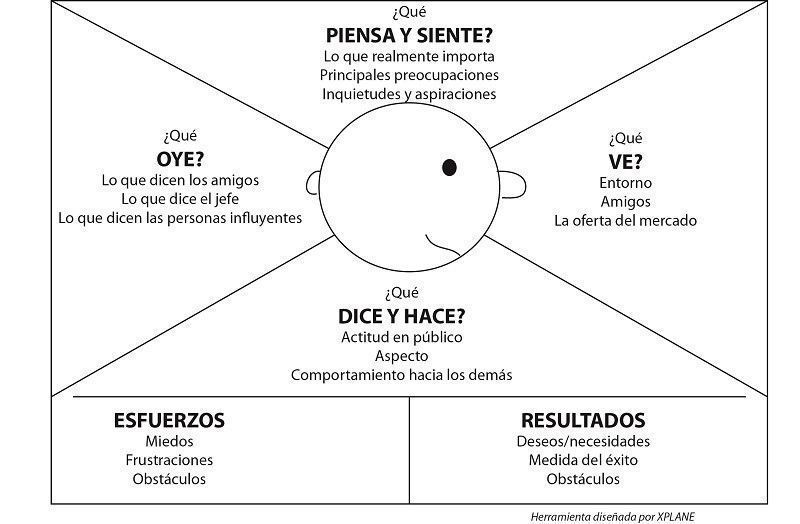
This is what an empathy map looks like. You may find them with a different look, but the sections are the same.
As you can see, at the center is our client/stakeholder with the sheet divided into different sections in which you will place the postits, answering each of the questions as you see fit.
A little reminder!
Xplane has created a new version of the empathy map, but I haven’t found it in Spanish, so everything I show you is made with the previous version. The new one doesn’t differ much from this one you see, except for a different aesthetic and a specific section for the initial definition of customers and their needs. This is already done in the version I am talking about, but it’s integrated in a different way.
Steps to follow in order to complete the empathy map
Next I will explain bit by bit what you have to put into it and I will do so with a practical example: the empathy map of a responsible consumer.
Step 1 – Name them and describe them briefly
This step is important for working with both customers and stakeholders. In the latter case, use the group’s name and give a brief description of the group’s general profile.
I also recommend that you add a picture or drawing of the profile or person you are working with, to assign them a face and make it easier for you to put yourself in their shoes.
Our responsible consumer will be called Cristina, Cris for friends. She is 42 years old, mother of a 4 year old boy named Adrián. She works part-time as an economist in a consulting firm and loves nature.
Step 2 – What does Cris think and feel?
We need to put ourselves in Cris’s shoes and think about what she really thinks and cares about, as well as her opinions about the things that matter to her and what her aspirations are.
- For Cris, her son comes before anything else and that’s why she has stopped working to spend as much time as possible with him during his first years. However, she also doesn’t want to stop working and that’s why she intends to gradually extend her working hours depending on the needs of her kid and the conciliatory measures she will be given.
- She’s worried that her company may think that she’s disposable due to the fact that she’s prioritizing her family.
- She’s also concerned about the state of nature, which is deteriorating, and believes that companies are the ones who have to get their act together and take care of the environment by being more responsible.
Step 3 – What does she see?
This section refers to the visual stimuli that your person or stakeholder receives.
- She sees that the park she goes to with her child is always full of trash and plastics.
- On TV and social media there is a lot of talk about climate change and the problem concerning plastics.
- A number of her friends have joined a consumer group to buy seasonal fruit and vegetables.
- She has noticed that as soon as people started talking about the negative qualities of palm oil, it only took a few weeks for many brands to remove it from their products without affecting their quality and price.
Step 4 – What does she hear?
At this point it is time to think about what she hears through her ears in all possible contexts.
- She hears her friends commenting on just how yummy tomatoes from a proper garden taste.
- She hears news about the future of the Earth her son will live on as a result of climate change.
- Another mother in the park has told her that since she reduced meat consumption at home and increased vegetable intake, everyone feels much better physically. It took some getting used to at first, but now they are all very pleased with it.
Step 5 – What does she say and do?
Flip everything around and put yourself in her shoes again. Think about what she does in her daily life, how she interacts with her friends and acquaintances, what things she likes to do, etc.
- Cristina hasn’t been using plastic bags at all for months now.
- She has signed up for a neighborhood workshop on how to make homemade preserves and canned goods.
- She walks virtually everywhere and if the distance is too long, she goes by bus.
- Whenever she discovers a new brand of environmentally friendly and non-toxic toys, she informs the other mothers in the park about it.
- Almost every weekend she, her boyfriend and Adrián go for walks and short outings in the countryside.
Step 6 – What efforts does Cris make? What struggles does she face?
In this section, you indicate what fears, frustrations and obstacles Cris encounters in her daily life in relation to all the issues raised in the previous sections.
- It is difficult to reconcile work and family life.
- She has little time for everything.
- There is little availability of sustainable products at affordable prices.
- She buys in a bulk store.
- She is afraid of what kind of world her son will be living in in the future.
- Companies give little information about their products, where they come from, how they are made…
Step 7 – Results
In this last section, write down what motivates Cristina, what her wishes and needs are, how she measures success and what obstacles she has overcome.
- Cristina likes having reduced the use of plastics at home.
- She hopes for Adrian to love the countryside as much as she does and for him to enjoy every outing.
- She feels empowered after having stopped buying certain brands for ethical and sustainable concerns.
- Thanks to going to work by foot, she no longer has to control what she eats so much.
If you are a company or entrepreneur, with the empathy map you can gradually put yourself in the place of the person or people you are interested in and from that point design a product, service or even a communication strategy focused on sustainability for them or for any of your stakeholders.
Will you give it a shot?
And one more thing!
Do you want more information about responsible consumers because they are your customer profile? You can download the report “Otro consumo para un futuro mejor” by theOrganización de Consumidores y Usuarios (OCU)and theNESI Forum which analyses consumer trends and the profile of this kind of consumer.
Finally, if you want us to help youdesign strategies or identify your stakeholderdon’t hesitate to contact us. .